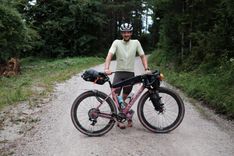
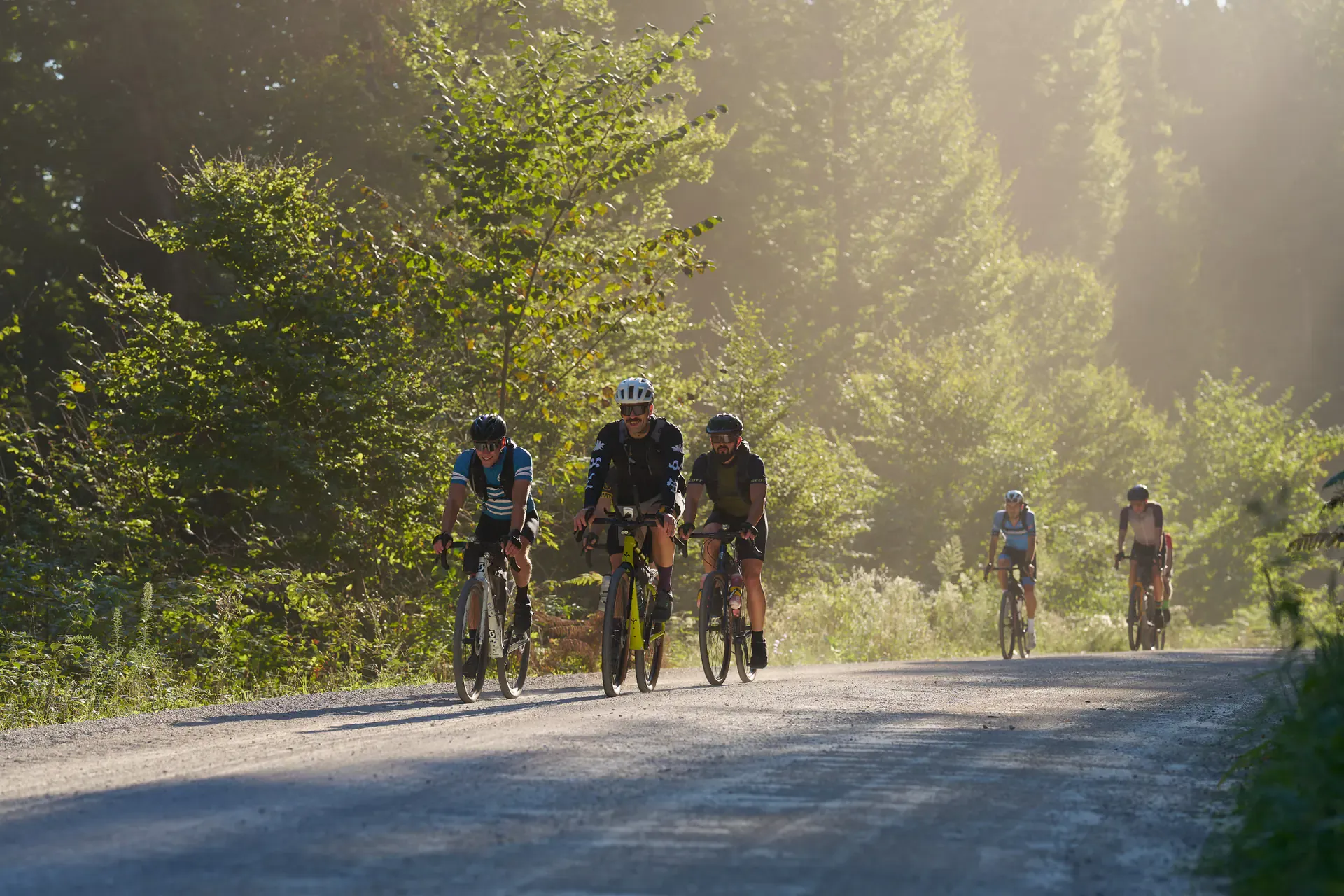
Here I am, writing another report of an event I hadn't planned or prepared for, but somehow found myself at the start line anyway. This time, though, it's a proper one. While it "only" qualifies as a long(er) gravel ride or a short(er) ultra by today's standards, a glance at the numbers the organisers are promising - 300 kilometres of the best gravel roads in the area and an eye-watering 7,000 metres of elevation gain - makes it clear this is going to be a real challenge. And somehow, almost all of that climbing is squeezed into the endless forests along the Slovenian-Croatian border, in a part of the world with no real mountains to speak of.
There are not so many crazy people around.
— Slavc somewhere around KM 190
As it turns out, the number of crazy people is just shy of 30.
The green border
The name of the event comes from the landscape through which the route travels: the heavily forested borderlands between Slovenia and Croatia.
The "green border" here is much older than the line separating the two modern countries. For centuries, the forests and hills of southern Slovenia formed a sparsely populated frontier, and Ottoman expansion and raids had a particularly significant impact on the region during the 15th and 16th centuries.
Parts of the wider borderland eventually became connected to the Habsburg defensive system against the Ottoman Empire, with nearby Žumberak incorporated into the Military Frontier. Refugees from Ottoman-controlled territories, including the Uskoks, settled in the area and helped defend the frontier.
Political borders have moved around plenty of times since then, but the geography hasn't changed much. Huge forests, ridgelines and sparsely populated valleys still dominate this part of Slovenia and Croatia, which makes it a pretty obvious place to draw a 300-kilometre gravel route.
Who is behind Green Border Gravel?
Green Border Gravel is the work of Adam Jordan, a cyclist from Kostanjevica na Krki whose idea of a reasonable day on the bike is probably quite different from that of most people.
Adam started racing when he was ten, became Slovenian junior road race champion and later raced at elite level for Adria Mobil and Ljubljana Gusto. After stepping away from road racing, he moved towards gravel and ultra-distance riding, including wins at Granguanche Gravel and Seven Serpents, to name just a couple of his more outstanding performances.
In August, he also became the first rider to complete the entire Slovenian Mountain Bike Route (STKP) in one continuous effort. The numbers are slightly difficult to comprehend: 1,841 kilometres and more than 52,000 metres of climbing in 6 days, 21 hours and 20 minutes. You can already find a short report on our site.
With that background, it makes sense that the event he built on his home roads is as hard as it is.
If Adam is the mastermind, Jaka Magister is the one who helped get the whole thing across the finish line, doing the organisational work that turns a route on a screen into something people can actually show up for. He's also part of gravgrav, helping with everything visual and actively involved in organising the Loose bikepacking events we do together with Loose Cycles.
Jaka and I have a slightly absurd history. During Covid, I drew a route called Gorenjska Gravel Epic, 290 kilometres with 8,500 metres of climbing, and accidentally made it public on Komoot. I never rode it. Jaka found it and did.
We didn't know each other at the time. Years later, when we finally met, he mentioned that he'd once ridden a brutal loop around Gorenjska that someone had put on Komoot. That someone was me.
So, what is Green Border Gravel?
Green Border Gravel is a 300-kilometre self-supported gravel adventure starting and finishing in Novo mesto. It is explicitly not a race, although putting a group of cyclists on the same start line, turning on the GPS tracking and recording their finishing times does inevitably result in at least some fast-paced riding.
The inaugural edition took place on 5 September 2026, with 28 riders starting and 21 eventually reaching the finish.
The basic numbers already make it sound fairly serious. There are almost 7,000 metres of elevation gain over 300 kilometres, with the majority of the route away from paved roads. From Novo mesto, it heads towards the forests of Kočevski Rog, continues along Stojna and Poljanska gora before turning back north and crossing Rog again. It then heads towards Gorjanci and Žumberak, before eventually turning back towards Novo mesto.
The route description talks about long and sustained climbing rather than particularly steep or technical climbs, which is technically true. What it doesn't quite convey is how relentless the accumulation of all those climbs becomes after ten or fifteen hours on the bike.
Friday: a social ride and a car park
The day before the start there was a social ride out of Novo mesto, a relaxed 29-kilometre loop with barely any climbing, which is exactly the right amount of riding to do the day before something like this.
Mostly, it was an excuse to talk. Bikes, tyre choices, what everyone was running for lights, who was planning to sleep and who wasn't, and a lot of catching up with people we hadn't seen in a while. The gravel scene here is small enough that you recognise most of the faces and large enough that you don't see them often.
Urban and I then went full dirtbag for the night. Dinner in the car park at the start and finish, sleep in the car, breakfast in the same car park the next morning while getting the bikes ready. It isn't glamorous and I wouldn't necessarily recommend it as a recovery strategy, but there is something quite fitting about starting a 300-kilometre self-supported ride from a sleeping bag in the back of a car twenty metres from the start line.
Relentless is probably the right word
There wasn't one particular climb that made Green Border Gravel difficult for me. Instead, it was the fact that the route almost never seemed to stop going either up or down.
You climb for a while, descend, get a short section where you think you might finally settle into some sort of rhythm, and then another gravel road disappears into the forest and starts climbing again. Even when the surfaces are good and no single climb stands out, the terrain constantly asks something from you.
My power meter conveniently decided not to work that day, so I ended up pacing almost entirely by heart rate. In hindsight, that might have been a good thing. Instead of worrying about watts or what everyone else was doing, I kept an eye on the number so it wouldn't go above 150 bpm on the climbs, while letting it settle somewhere around 130 bpm on the flats and descents.
For the most part, it worked, although things definitely weren't smooth all the way through. Somewhere around kilometre 140, I had a proper crisis, roughly where the longest climb of the route, up towards Trdinov vrh, begins. The legs weren't cooperating, I couldn't find a comfortable rhythm and, with more than half of the route still ahead, things weren't looking particularly promising.
It didn't help that I was riding most of the day with Tilen Likar, who at exactly that moment obviously felt fantastic and was making me hurt. A gel and some suitably explosive music got me through it, and after a while the legs came back. Strangely enough, from then on they felt almost golden.
There was still a lot of climbing left and it never got easy, but I was able to keep moving towards Novo mesto pretty confidently.
Into Žumberak
After reaching Trdinov vrh, the route dropped onto the Croatian side of the border and into Žumberak, where the roughest part of the ride was waiting for us. It was probably also the most remote, with rough, rocky tracks cutting through a forest that had an almost primeval feeling to it.
One particular section reminded me of the Lynx Trail, which I rode a few years ago. The path looked like something the Romans might have built, with rocks laid into the ground and the forest slowly reclaiming everything around it. It probably had absolutely nothing to do with the Romans, but after that many hours on the bike it certainly looked ancient enough.
Almost immediately afterwards, the character of the route changed completely. The rocks gave way to what felt like a gravel highway, and suddenly we were flying again. After some of the roughest and most remote riding of the day, that fast stretch of gravel leading us back towards Slovenia felt ridiculously good.
Looking back, the conservative pacing early on definitely paid off. I never reached the point where I was just trying to survive the final kilometres or desperately dragging myself towards the finish. In fact, I was pushing relatively hard for the final two hours, chasing a completely arbitrary goal I had set myself: 305 kilometres at an average of 20 km/h.
Spoiler alert: the average on my Wahoo at the finish was exactly 20.0 km/h.
Self-supported, with pancakes and pasulj
Green Border Gravel is self-supported, so there are no organised feed zones waiting along the route. Shops, restaurants and other publicly available services are fair game, though, and deciding when and where to stop becomes part of the ride.
Apparently my approach to ultra-distance nutrition involves sitting down for proper food.
At Mirna Gora, pancakes and a bowl of pasulj, a thick bean stew that turns up on every mountain hut menu around here, seemed like a very sensible idea. Well, I only wanted the pancakes, but the lady at the hut was persistent and I had to give in.
Later, in Šentjernej, we stopped again for fries that Slavc had arranged for us. Yes, Slavc, the same Slavc who rode 400 kilometres across the Alps while gaining 10,000 metres of elevation along the way. Neither stop was particularly efficient if the goal was to get around the route as quickly as possible, but both made the whole experience much more enjoyable.
In the end, I reached the finish after 16 hours and 44 minutes, of which 15 hours and 14 minutes were actually spent moving. That's quite a bit of stationary time if you're looking at the results and wondering where those extra minutes went, but I have absolutely no regrets about spending some of them eating pancakes.
Could I have finished faster with shorter stops? Almost certainly. But Green Border Gravel isn't officially a race anyway, right?
What stays with you
What I'll remember from the inaugural edition isn't one particular climb or descent, but the cumulative effect of the route. It just keeps going through huge forests and over one ridge after another, without ever giving you much of a chance to switch off.
Urban, who I'd driven down with and shared the car with the night before, was riding strongly until saddle sores ended his day around halfway.
I rolled in a few minutes before one in the morning, fifth overall (not a race, remember), had a celebratory beverage and a warm meal, and went straight back to the same car park to sleep. Five hours later, I was woken by applause for another rider arriving at the finish. I can't think of a more fitting way for the weekend to end than lying in the back of the car listening to someone else finish the same ridiculous loop we'd all set off on the morning before.
There are no Alps here and no enormous mountain passes to explain the elevation profile. Adam found almost 7,000 metres of climbing in 300 kilometres anyway, which might be the most impressive and slightly disturbing thing about the whole route.
Brutalism à la Adam Jordan at its finest.


