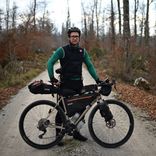
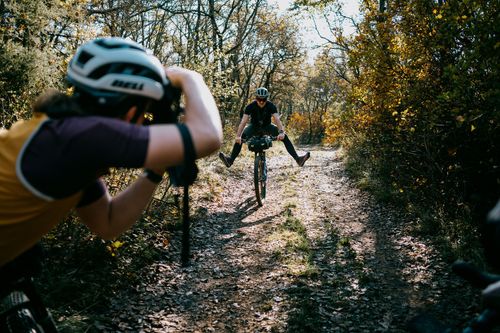
In November, my friend Žan and I tested two of the latest Nikon mirrorless cameras on a bikepacking trip (thanks to the generous folks at Nikon Slovenia). I was curious to see how the crop-sensor Nikon Z50 II would compare against my full-frame Nikon Z6. Wanting a bit more flexibility than the heavier full-frame lenses usually allow, I brought along a Nikkor Z 18-140mm zoom and a lightweight, optically excellent Nikkor Z 24mm f/1.7 prime. Žan, otherwise a Fuji shooter at the time, tried a full-frame Nikon Z5 II with a pair of compact primes.
Without much concern, this informal review could stop right here, since we both ended up replacing our previous cameras with a Nikon Z5 II. Still, there’s a small caveat: I think the smaller Z50 II was the true star of our little bikepacking trip - read on to find out why I think it may be a perfect bikepacking camera.
tl;dr
Since this is a rather long review, here are the key points before we dive into the details:
- Nikon Z50 II + 24 mm f/1.7 make for a lightweight APS-C kit at approx. 680g.
- Compact body with weather sealing and reliable subject-detection autofocus at an accessible price (approx. €865 for the body and €1,165 with the 24 mm f/1.7).
- 24 mm f/1.7 is small, sharp, and well-suited for travel and documentary photography.
- While the camera offers no in-body image stabilization, most zoom lenses are stabilized.
- Size and weight are comparable to a Fujifilm X-T5, making it very manageable for bikepacking.
- Compact lens options are expanding, both in Nikon’s native lineup and from third-party manufacturers, offering more flexibility for lightweight setups.
What makes a perfect bikepacking camera?
But hey, what actually makes a perfect bikepacking camera, and what features should it have? Ideally, it should be pocketable yet full-frame, weigh next-to-nothing, yet offer at least 24-200mm at f/1.8. It should, of course, survive a thunderstorm and lock focus instantly - all this at the price of a mid-range smartphone.
Jokes aside, any real camera will be some sort of a compromise. In my experience, the best cameras - for any task - are the ones that don’t get in the way of the process. Rather than forcing me to slow down and focus on the moment (often a convenient marketing excuse for a laggy interface or sluggish focusing), they quietly do what they were supposed to do.
In bikepacking photography, not getting in the way also means being an accessory rather than a burden. Of what use is the latest and greatest heavyweight flagship camera if it only strains my back while riding and I rarely feel like taking it out to shoot? For that reason, I believe modern mid-range mirrorless models make the most sense for bikepacking.
Whether APS-C or full-frame, they offer excellent image quality in relatively compact bodies, often with at least some degree of weather sealing. To keep things light, I’d pair one with a compact normal prime - say, a 40mm f/2 on full frame - small, versatile and fast enough for most situations. Often, I’d complement it with the wide angle lens of my smartphone. Under special circumstances, such as group rides or bikepacking events, I’d consider bringing a second lens, possibly even a compact zoom.
Mid ride, I carry the camera on my back, secured safely by a three-point camera strap. This prevents it from swaying around while riding, but keeps it easily accessible should a photo opportunity arise. In rain or over sketchier terrain, I stash the camera away in a What Happened Outdoors custom camera hip bag, which also holds a second lens if I bring one. For extra protection, I usually include a dry bag and some desiccant baglets. I’ve noticed it always rains when I forget those.
To reduce back strain and balance weight, I keep accessories like spare batteries or chargers in the framebag or handlebar bag. Carrying the camera in a hip bag also minimizes the risk of expensive damage if the bike tips over and helps dampen the microvibrations of gravel riding, which can be harsh on modern cameras, particularly those with in-body image stabilization (IBIS).
A brief disclaimer before we focus on particular cameras: I have around fifteen years of experience with Nikon cameras, so they are naturally the ones I’m most comfortable with, though much of what I say applies equally to other modern camera systems. While the cameras in this review were kindly lent to us by Nikon Slovenia and Foto Grad, we received no sponsorship, and this review reflects my independent experience and opinions.
Choosing our Nikons
In September, we started planning our upcoming Loose at the Coast bikepacking event. It all began with a WhatsApp group, where we eventually settled on a three-day route scouting trip in November. We had an ambitious plan - trying to cover about 400 km of unknown terrain within three days with limited daylight, while also frequently stopping for photos.
In hindsight, we were clearly overly ambitious - but this is the focus of Žan's article on route scouting, not mine. What matters here is the gear and, as with all things bikepacking: lighter is better. Knowing I’d be responsible for taking photos, I started thinking about a lighter alternative to my full-frame Nikon setup.
On some of our previous trips, Žan kept borrowing my Nikon Z6, raving about its focusing speed and perfect button layout. I, on the other hand, began experiencing lower back pain while carrying a camera, even on shorter outings. This was particularly noticeable on social rides, where I’d typically bring a 24-70mm f/4 zoom lens and a 40mm f/2 pancake prime. The former gives me more flexibility in a dynamic group setting, while I simply love the rendering of the latter.
All in all, this is a massively capable setup, but also one that weighs well over 1,300 grams, batteries included. I figured our upcoming scouting trip would be a perfect opportunity to reach out to Nikon Slovenia and ask whether they might be willing to lend us a couple of cameras and lenses for a real-world bikepacking test. Their affirmative answer came quite quickly, so we only had to make up our mind about what gear we actually wanted and needed.
Žan's full-frame setup
From the start, Žan was set on going full-frame, but with the smallest possible form factor. Based on my experience with the first-generation Nikon Z6, I suggested the latest Nikon Z5 II along with a 40mm f/2 prime, and possibly a 28mm f/2.8. Visually, those two lenses are identical and weigh about 170 grams each, so bringing two instead of one hardly strains one’s back. Personally, I am a big fan of the 40mm lens: it works well in a variety of settings and renders nicely wide open. Technically, it is far from a clinically perfect lens - which it was never meant to be anyway - but it is still a far better performer than any of the DSLR-era alternatives.
At least for me, the introduction of these two lenses marks the point when Nikon mirrorless truly became a viable option for bikepacking photography. Before that, the slender and lightweight camera bodies either had to be paired with bulkier (but optically excellent) native Z-mount lenses or with adapted DSLR f-mount lenses, which added more weight and complexity.
As for the camera, it brings the imaging processor and autofocusing features from Nikon's flagship models into a compact body, tipping the scales at around 700 grams. While my Nikon Z6 is already a very capable camera - not just for bikepacking - Z5 II is a clear step forward in virtually all aspects that matter. Surprisingly, a similar thing can be said about the Z50 II: despite its smaller, crop-sensor form factor, it brings many of the same improvements in processing and autofocus, making it a genuinely capable camera for bikepacking without the weight of a full-frame body.
Testing the Z50 II
In my case, I opted for two lenses that would keep the setup light while covering very different needs. Read more about them below.
Nikkor Z 18-140mm f/3.5-6.3
Knowing we’d be riding through open terrain, I wanted a bit of compression for shots of riders moving across the landscape. On full frame, achieving that kind of reach would have meant carrying a much bulkier telephoto - exactly what I was trying to avoid. This is where the advantages of a smaller sensor become obvious: the versatile, image-stabilized 18-140mm f/3.5-6.3 weighs just 315 grams. The lens retails for about €550.
I’m usually wary of superzooms that stretch from wide angle to telephoto, but this was by far the lightest way to get the range I had in mind. Besides, these are no longer the dreaded superzooms of the past. Inevitably, there are trade-offs in a lens like this, yet in real-world use I had few complaints about image quality. The generous zoom range also reduces the need for lens changes, which is always a welcome benefit in dusty conditions.
According to the manufacturer, the lens is sealed against dust and moisture, though not to the same standards as Nikon’s professional optics. The build quality follows the same logic: perfectly solid and well assembled, but not quite as confidence-inspiring as higher-end glass. Then again, this is an affordable, entry-level lens, and with that in mind, it performs admirably. Just treat it with a bit of care when the going gets rough.
I brought this lens with a specific task in mind, so I wouldn’t exactly call it essential. But once your main lens is sorted, this is a very practical addition whenever you need extra range without adding much weight.
Nikkor Z 24 f/1.7
The other lens I brought along was the small and lightweight 24 mm f/1.7 prime. I have no reservations about this one - it’s an easy recommendation and arguably the ideal companion for any DX mirrorless Nikon. With its 36 mm-equivalent field of view, it hits a sweet spot for documentary-style photography: wide enough to give context, yet natural enough to avoid distortion.
In real-world use I’d say its optical performance even surpasses that of the 40mm f/2 on FX. The rendering is crisp, contrasty, and consistently sharp. At just 135 grams, it keeps the setup remarkably light: paired with the Nikon Z50 II, the whole kit comes in at roughly 680 grams with battery included. The lens is also affordably priced at around €290.
Nikon Z50 II
What I particularly liked about the Z50 II is that it feels more like a compact Z5 II than a budget entry-level camera. It is small and light, but at the same time surprisingly capable. Aside from the missing joystick - something I rarely use anyway - the control layout is very similar between the two cameras and I also appreciated the substantial grip. All of the most important functions can be assigned to buttons, something I am used to from higher-end Nikons, so there is not much need for menu diving.
Although I refer to this camera as compact throughout the review, it is not pocketable in the way a true point-and-shoot is. At around 550 g, it is actually slightly lighter than the Fujifilm X-T5, a model well regarded among bikepackers. In terms of dimensions (127 × 96.5 × 66.5 mm), the Nikon occupies a very similar footprint: marginally narrower, slightly taller, and a touch thicker than the Fuji. In practice, the difference is negligible, since both cameras fall into the same category of small but seriously capable cameras. What the numbers don't capture is how much of a difference the whole setup makes on the bike. Carrying the Z50 II with a zoom and a prime felt noticeably lighter than my usual full-frame Z6 setup, especially when hauling a second lens in the hip bag. The size comparison is based on the Camera Size Comparison Tool.
The Z50 II uses the tried-and-true 20.9-megapixel sensor from Nikon’s pro-grade D500, a camera many sports photographers swear by. Sure, low-light performance won’t quite match a full-frame body, but in the cropped-sensor world, it definitely performs very well. I also never found myself wishing for a higher megapixel count. For bikepacking photography, 20.9 megapixels are more than sufficient.
Autofocus is fast and reliable thanks to a hybrid phase- and contrast-detection system, with 209 points in single-point mode or 231 in auto-area mode spread across almost the entire frame. In plain English, these specsheet figures translate into a remarkably capable autofocusing system that certainly exceeds those in previous-generation Nikon mirrorless cameras, including my aging Z6.
Another standout feature was the subject and face detection, powered by Nikon’s EXPEED 7 processor - the same as the one in Nikon’s top-tier Z9 and Z8. On the scouting trip, I remember getting ahead of the group to frame a shot of the riders coming down a trail; by the time I stopped, the viewfinder fogged up from my effort. Even then, the camera locked onto the riders instantly, and I captured exactly the image I wanted without having to think about focus at all.
Perhaps my only major complaint about the camera relates to its lack of in-body image stabilisation which I got used to on full-frame mirrorless Nikons. While this is not that much of a problem with stabilised zoom lenses, I did notice it when using the prime in low-light situations. However, skipping IBIS is probably what helps keep the camera more compact and also keeps its price down at around €865 body only.
All in all, this is certainly not a camera that gets in the way. It’s fast, responsive and intuitive to use, with an advanced focusing system as its main selling point. In the best way possible, it feels and behaves like a Nikon, which makes it a perfect everyday camera for professionals and serious amateurs looking for a lighter alternative to their main kit. For these same reasons, it’s also an ideal bikepacking companion, particularly when paired with the 24mm f/1.7 prime.
Conclusion
The Nikon Z50 II genuinely impressed me on our three-day bikepacking trip. At the time, I was in the market for a new camera, and although I eventually chose the full-frame Nikon Z5 II, that decision was largely shaped by the confidence I gained in its smaller sibling.
Truth be told, I bought the Z5 II solely on trust, without testing it beforehand. I wasn’t chasing better image quality since my Z6 still delivers beautifully, and the Z5 II uses the same sensor. What I wanted was newer processing power and more advanced autofocus capabilities. After seeing what the Z50 II could do, I felt confident that the larger (and admittedly more expensive) body would only build on that foundation.
I’ve also really enjoyed working with the 24mm f/1.7 prime. For under €1,200, this combination delivers a bright and versatile lens, fast autofocus, and modern ergonomics in a compact package. On top of that, new compact lens options are finally starting to appear for both full-frame and APS-C systems.
One I’m particularly eager to try is the newly released 16-50mm f/2.8. A copy arrived at Nikon Slovenia just as we were heading out for the bikepacking trip. From a first look, the build quality seems solid, the zoom range mirrors what I typically use on full-frame, and it weighs about the same as the 18-140mm, so carrying it won’t be an issue. Hopefully, it won't take long before I find out whether it's the ideal bikepacking setup.