Last November, we set out on a bikepacking trip to scout the route of the upcoming Loose at the Coast event and make some promotional photos along the way. We also took it as an opportunity to try out different bikepacking setups and to test two Nikon mirrorless cameras kindly lent us. Read about our findings below.
And who are we? Jan, Jaka, Boris, and I; four avid cyclists with slightly different bikes, gear preferences, and very different definitions of “reasonable luggage”.
So without further ado, let’s dive into the technical side of the trip: the bikes, the gear, and the photography equipment we decided to haul around for three days.
I realise this came out as a rather long text, so here’s a TL;DR:
- (Nikon) Mirrorless cameras are portable enough to carry around for days.
- A three-point camera strap is an excellent way to carry a camera while riding.
- A Tailfin Cargo Pack with a camera insert makes a remarkably good bikepacking camera bag.
- Don’t plan 100+ kilometers per day if you want enough time for proper photo stops.
- When exploring rugged, unknown terrain, a hardtail makes things more comfortable.
- 1 kilo of pasta is a lot of pasta.
Cameras first: two Nikons, four lenses
Some context: Jan already owned a Nikon Z6 and was curious to see what a modern APS-C sensor in a compact body could deliver. I, meanwhile, had been shooting with a Fujifilm X100 VI at the time, a great camera for sure, but was not amused with its autofocus. Only after a weekend with the Nikon did I realise the Fuji's ergonomics are a bit off, compared to the Nikon, where every button was exactly where it needs to be. Furthermore, I was really keen to test the supposedly entry-level Z5 II in real-world conditions. I can tell you it proved capable of far more than the label suggests. Heck, I even sold my Fuji and replaced it with the exact setup I shot with during our escapade.
As already said, I set off with the full-frame Nikon Z5 II and two lightweight prime lenses (40 mm f/2 and 28 mm f/2.8), which proved to be a near-perfect setup for riding and shooting on the move. Fast autofocus and intuitive controls allowed me to grab shots quickly, often without even stepping off the bike.
Jan opted for the smaller and lighter Nikon Z50 II, paired with the 24 mm f/1.7 and 18–140 mm lenses. He was particularly impressed by the pocketable 24 mm; its 36 mm full-frame equivalent focal length was great in almost any situation. He was pretty amused with the combo and even decided to share his experience. Read his full-on camera review here.
All the Nikon gear was generously lent to us by Foto Grad, for which we’re hugely grateful.
Bikes and bags
The group split evenly between gravel bikes and hardtail mountain bikes.
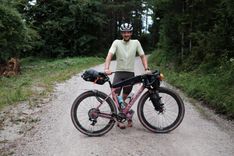
Jan and Jaka rolled in on their trusty steel gravel rigs: a Fairlight Secan and a Brother Mehteh, while Boris and I opted for our adventure-ready carbon hardtails. No judgment, please. I’d love to own a steel hardtail, but a second-hand Cannondale Scalpel HT at half the price was hard to say no to. Boris rocked his pimped out BMC Twostroke. We are talking Rockshox SID Ultimate, plush as butter, and 690 points of engagement of the Hydra hub buzzing like a swarm of busy bees.
Bag setups were similarly divided. Two points for Tailfin, two points for Ortlieb, with a bit of extra bag diversity for good measure.
The Tailfin Cargo Pack, paired with a camera insert I used, turned out to be an excellent camera bag. I was able to pack the camera, an additional lens, and the DJI Mavic Mini with the controller, leaving room for a sleeping bag and a few extra layers. I did add a 10 L mini pannier to the side of the arch, which helped keep everything organised - or at least contained. A Decathlon feedbag also proved invaluable, allowing me to keep a second lens within arm’s reach at all times.
Jan used a hand-crafted What Happened Outdoors hip camera bag for the camera equipment, and packed the rest in classic Ortlieb frame, seat, and bar bags. As a long-time Ortlieb fan, he seemed content, though I suspect he wouldn’t mind a Cargo Pack either 😆.
We both opted for a three-point camera strap - it is a great way of safely carrying the camera while riding, whilst having instant access when a nice photo appears in front of you.
The plan
We had a rather optimistic plan. Ride 410 km with 6000+ meters of climbing in three days, a substantial part on an unknown and rugged terrain, scout parts of the Loose at the Coast event route, and make regular photo stops to create some promotional material for the event.
Loose at the Coast, as the name suggests, will happen in the coastal region of the country. But we live inland, beneath the mountains, so the first day was largely about getting from Ljubljana, where we met, to the coast and ultimately to the Karst. We had a reservation at Hostel Pliskovica, but I had a certain photo in mind - a drone photo of a group of riders on a twisty gravel uphill to Mt. Kokoš in the lovely golden light - so we had to make a detour via Kozina.
Long story short, the transfer was an absolute blast! I rode to the coast several times already, but this time I planned a route along some unknown roads that turned out to be just perfect! I will definitely use them in the future. We even recreated the Into the Wild bus photo, with Jaka as Christopher McCandless.
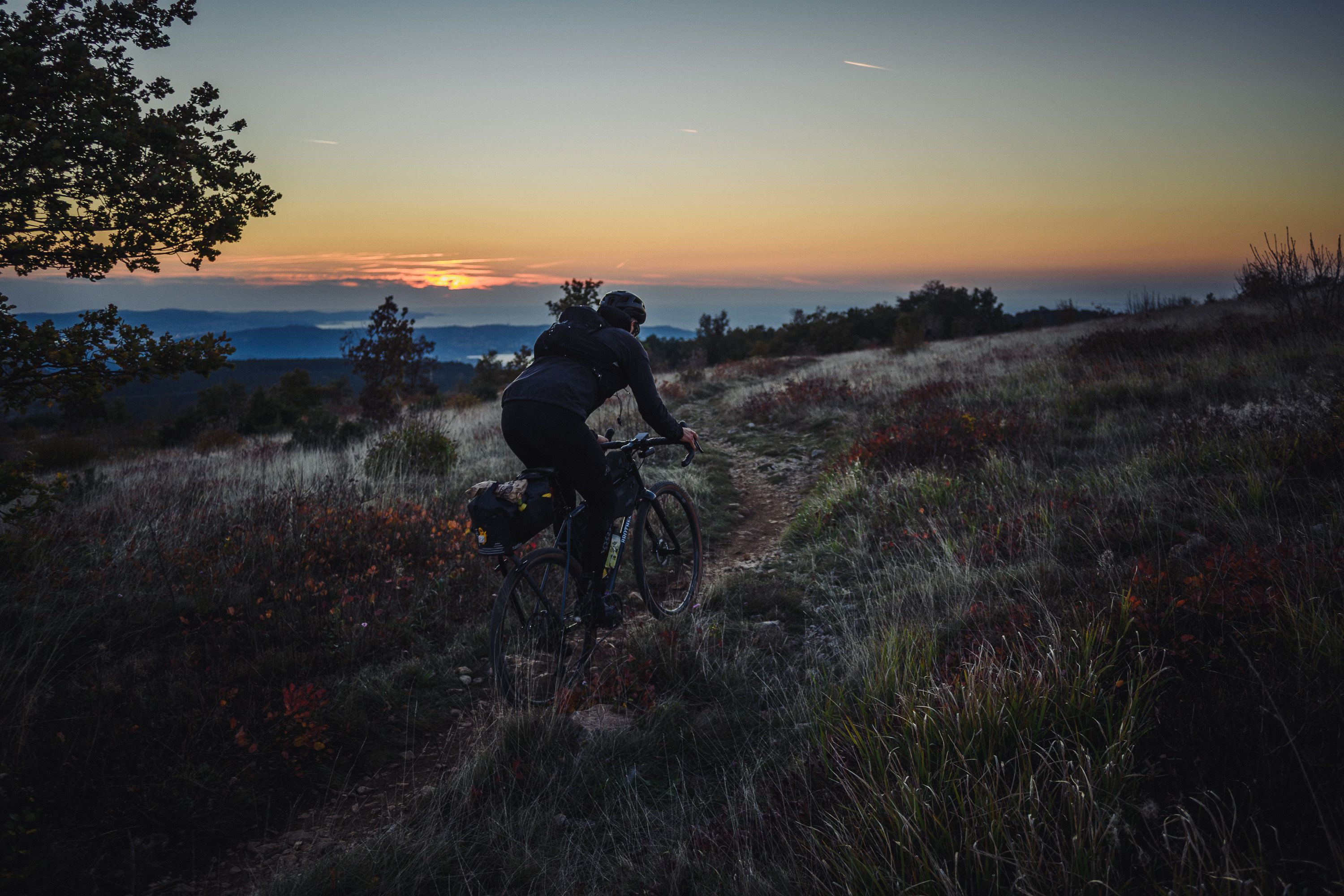
But - there is always a but - days in November are pretty short, and we arrived in Kozina just before sunset - about half an hour too late. The Bora wind was also not in our favour, as it would not allow the takeoff of a tiny Mavic Mini. But we did not give up; we still managed to take some sunset photos from the southwestern slope of Mt. Kokoš, overlooking the Gulf of Trieste.
The final two hours of riding were done in the dark, with a quick stop at a bakery in Bazovica. Well-prepared and well-lit, we rolled into Pliskovica safely and smoothly. That was 160 out of 410 km of the trip done and dusted!
Day two: Reality hits
We began with an outside breakfast on a sun-lit bench. There was about half a kilo of leftover pasta from yesterday's dinner that we tried to finish off, but failed miserably.
Once packed, we took off along the route planned for the day. A few pleasant kilometers along the Karst plateau, and it didn't take long until we found ourselves on the Italian side of the border. Ciao ragazzi! The route I drafted took us down some rocky mountain bike trails, unintentionally, of course. Boris and I reached the bottom grinning. Jan and Jaka were less enthusiastic. I wonder why.
Once at the coast, we steered onto a trail with an incredible view of the Adriatic sea, arguably the highlight of the route, especially since it also passes along the Strada Vicentina - better known as Napoleonica - a picturesque climbing area where I spent many days in the past. Things went a bit sideways soon after, as we found ourselves inside a fenced pasture. As stubborn as we are, we did not consider going back and around, so we spent more than an hour finding our way out of the fence. Don’t worry, the final Loose at the Coast route will spare you this experience.
After 50 km and 5 hours on the bike, we reached Kozina. With this incredible pace in mind, we realised we would need to adapt the route for the second half of the day, as the accommodation for the night was still quite a distance away. We agreed to take a more or less straightforward path towards it, but as the sun slowly set, we just had to make a detour in the hope of reaching some scenic spots at just the right time for perfect light.
We did end up with some nice-looking photos and, again, spent the last few hours of riding in the night. Another kilo of pasta and off to bed! Regardless of the route diversion, we still did 128 km, but not without casualties - both Jaka and Boris were experiencing knee pain, thus we decided to take it easy on the last day.
Day three: Easy roll back
You guessed right, the day began with the leftover pasta and another miserable fail. But the alternative route we came up with was definitely not a fail - a mixture of single and double track trails, loose gravel roads, and a relatively low percentage of tarmac got us to the Dragonja valley.
Although not featured in this year's LATC route, we discovered some absolutely stunning paths. Spoiler alert: those who plan to join Friday’s shakeout ride will get to experience a tiny part of them.
From Dragonja valley, we took the Parenzana express back to Koper, had a tasty lunch seafood lunch, treated ourselves to the best ice cream in town, and then took the train back to Ljubljana.
Mission accomplished!
Epilogue
We met again in January. This time, for the “gravgrav goes non-profit” meeting, where we drafted the non-profit statute and got everything ready for its registration. We, of course, brought bikes and scouted the remaining sections of the Loose at the Coast route. When we opened registration for the event soon after, an unimaginable thing happened: it was booked out in a matter of minutes. The interest and enthusiasm we are experiencing is just out of this world, and we cannot wait to meet again in April!


