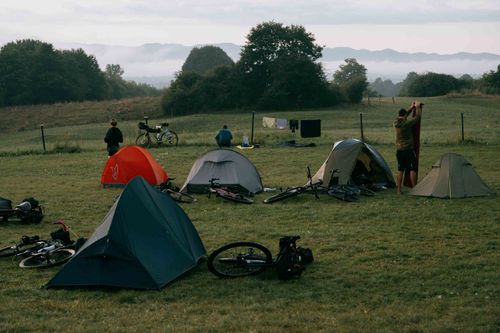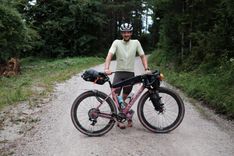
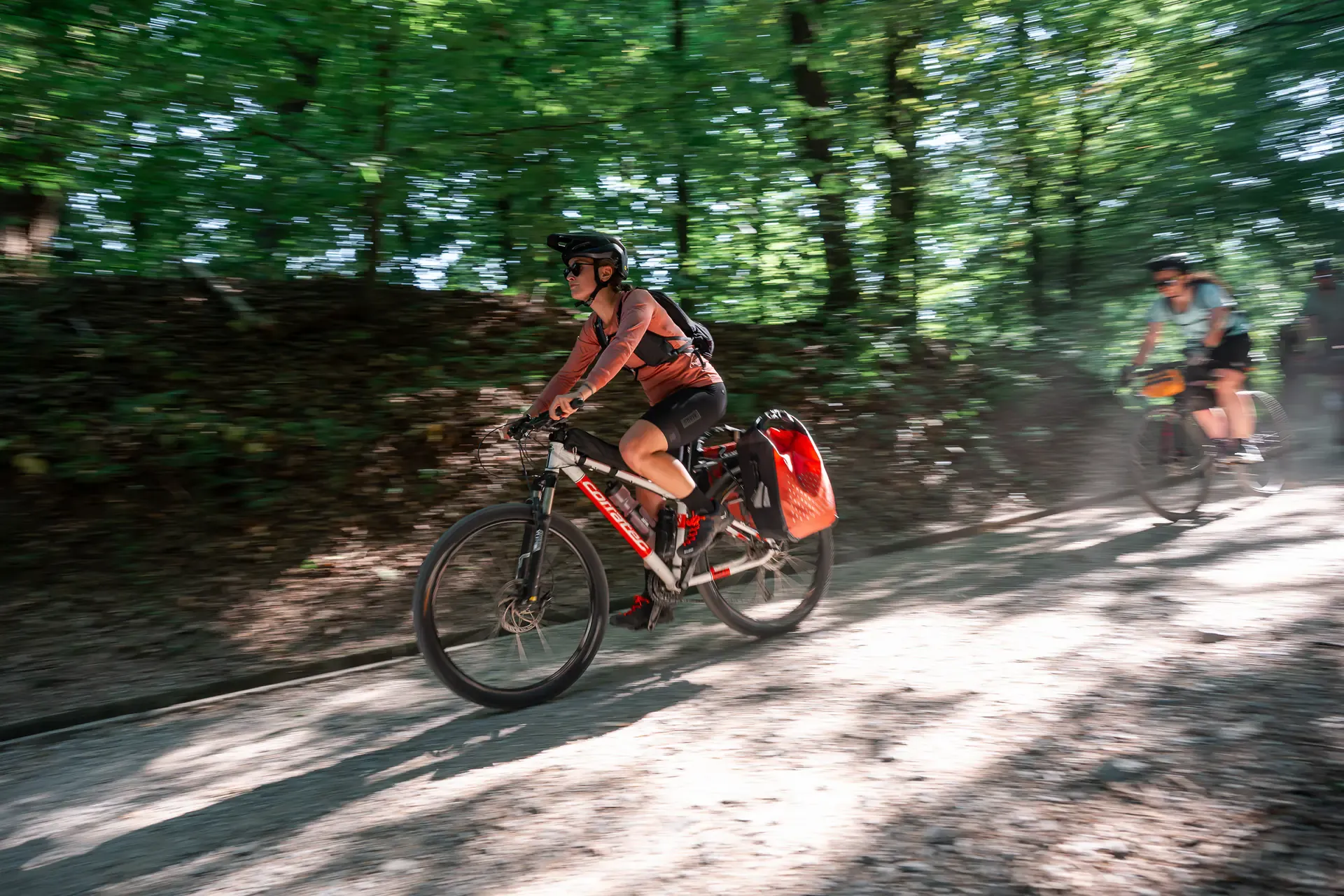
I love prime lenses. The image quality they offer in a relatively small package, and even though you have to zoom with your legs rather than by turning a ring, makes them my number one choice most of the time.
But there is always a but. The flexibility of a zoom lens starts to make a lot of sense when you're chasing riders along a 100 km route, day after day, in extremely dry and dusty conditions. Constantly swapping lenses suddenly doesn't seem quite as appealing.
So, for this year's Loose in the Woods, I decided to try the Nikkor Z 24–120mm f/4 S, kindly lent to me by Foto Grad and Nikon Slovenia - thanks, guys!
Here's a quick recap of a weekend with the lens, and how the experience compared with the 28mm/85mm prime combo I used to cover Loose at the Coast in April.
The lens
The Nikkor Z 24–120mm f/4 S is an S-Line full-frame zoom covering a very useful range from a genuinely wide 24mm to a fairly substantial 120mm. It has a constant f/4 aperture throughout the zoom range, a minimum focusing distance of 0.35 m, and weighs around 630 g. At roughly 118 mm long, it's not tiny, but considering the range it covers, it is surprisingly compact.
I've also spent some time with Nikon's Z 24–70mm f/4 S in the past, so the 24–120 isn't my first experience with an S-Line f/4 zoom. The 24–70 is a great little lens, but for this kind of photography, the extra 50mm at the long end makes a surprisingly big difference. To my eye, the 24–120 also produces noticeably sharper results. And considering how much more reach you get, the size penalty isn't particularly dramatic.
It is also weather sealed, something I appreciated quite a bit after spending three days riding through clouds of fine summer dust.
On the bike
For a lens with this kind of range, it carries surprisingly well. It balances the camera body nicely and doesn't feel too heavy on the back while riding. I use a three-point camera strap to stabilise the camera, which means it stays relatively secure but is still immediately accessible when something worth photographing happens.
And that is where the 24–120 really started to make sense.
With primes, I'm constantly making a decision about which lens should be on the camera. A 28mm works beautifully for environmental shots, groups, and immersive point-of-view shots that make you feel like you are right there in the moment, while the 85mm offers a completely different perspective and lets me isolate riders against the landscape. The problem is that the lens you want is inevitably in the bag when something happens.
With the 24–120, there is very little it can't cover. At 24mm, you can capture a rider along with the surrounding trail and landscape. A quick turn of the zoom ring and 120mm lets you compress the scene, pick out a rider further down the road, or isolate details without having to sprint ahead.
That flexibility is particularly valuable when photographing an event from the bike. You don't control where the riders are, you don't control when something interesting happens, and you usually have only a few seconds to get the shot before everyone disappears around the next corner.
Sharp. Really sharp.
Autofocus and image quality are outstanding, which is more or less what you would expect from an S-Line lens. What I didn't expect was for it to be that sharp throughout the zoom range, even wide open.
And yes, "wide open" here means only f/4. Coming from fast primes, that sounds rather slow on paper. In practice, though, f/4 is plenty for almost everything I photograph during a bikepacking event. During the day, there is more than enough light, and at the longer end of the zoom range, you can still get plenty of subject separation.
Low light is where the primes obviously fight back. When the sun disappears, and ISO starts climbing, a fast prime gives you a two-and-a-bit-stop advantage that no amount of zoom flexibility can replace.
24–120 vs. 28 + 85
This is probably the more interesting comparison.
At Loose at the Coast, I used a 28mm f/2.8 and 85mm f/2 combo. I love the results from that setup. The lenses are small, fast, and give me two very distinct ways of looking at a scene.
But it also means carrying two lenses and, more importantly, changing between them.
During Loose in the Woods, that would have been particularly annoying. The trails were exceptionally dry, and riding in a group often meant being surrounded by a cloud of very fine dust. Taking the lens off the camera in those conditions was something I wanted to avoid as much as possible.
The 24–120 stayed on the camera.
And perhaps that is its biggest advantage. It isn't necessarily about replacing a bag full of primes because it produces exactly the same images. It doesn't. Instead, it removes a whole series of small decisions: which lens to bring, which one to mount, whether there is time to swap it, and whether opening the camera in a cloud of dust is really such a good idea.
So, am I done with primes at Loose events?
No.
I still love the simplicity, size, and speed of a good prime, and for slower photography where I have more control over the situation, they remain my first choice.
But after three days in the woods, I understand the appeal of the 24–120 much better.
It covers a ridiculous range without becoming ridiculously large, the image quality leaves very little to complain about, and f/4 is a perfectly reasonable compromise for something that can go from a wide environmental shot to a tight rider portrait with one turn of the wrist.
Interestingly, though, I noticed that I often ended up using the lens at either end of its zoom range — either wide at 24mm or all the way out at 120mm. Sure, there are plenty of shots from somewhere in between, but perhaps that's simply how I'm used to seeing things after shooting with the 28/85 combo for so long.
And there is something else I still like about primes: the limitation itself. A zoom lets you quickly adapt the lens to whatever is happening in front of you. With a prime, you have to adapt yourself. You move, look for a different angle, work with the light, and think a little harder about the composition. Sometimes that limitation pushes you towards a photograph you might not have made with a zoom.
Am I ready to give up the primes? Definitely not. But the 24–120 has made the decision a lot harder. At our next Loose event, choosing what to put on the camera might be the most difficult part of packing.
28 + 85 or 24–120? Ask me after the next one.